3.
The Liangshan Workers
In 2006, in Shipai township in Dongguan, I met some workers from Liangshan. They all came from Meigu and Zhaojue counties. Their sharp-wittedness seemed laced with a faint timidity, and they moved in their own circles. In fact, they were eager to speak with other workers, but were too shy to do so. Most of them were Yi – an ethnic group I have much affection for. Until I met them, my main associations with the Yi were of the Liangshan mountains, the Torch Festival, lakes, poetry, shamans, the Bimo religion and scripture masters. Even these words connected with them seemed poetic.
The Liangshan workers I met were mostly young; quite a few of them were child labourers. Their deeply tanned skin made them look older, but their eyes told me they were still children, probably between 15 and 18. Some of them appeared even younger, closer to 12 or 13, if that.
I’d encountered child labourers before, when I worked on the assembly line and in other jobs around industrial zones. But it was still a shock to see so many children from the same area. What remains in my memory are the young girls. They were so thin and small for their age – and so guileless. These Liangshan workers were not free labourers. Their parents had signed a contract with – or rather made something approaching a ‘sale’ to – a foreman who promised them 10,000 yuan a year per child. Sometimes it was more like 5,000.
I lived for eight years on the assembly line: at electronics factories, toy factories, plastics factories (where I was an injection mould operator), hardware workshops (where I was duty manager) – I had experienced them all. I was familiar with the hard physical labour and institutionalised overtime that such jobs demanded. As I looked at these children’s faces, it was too painful to picture them there.
*
Abu told me he was 17, but he seemed even younger. He smoked, trying his best to look tough and worldly. Among the four or five workers from Liangshan that he roomed with, he had arrived first, four years earlier, and he was their leader. They all came from the same township, although not the same village, and they worked for the same foreman.
I spoke with Abu for two hours at a table outside a convenience store in the industrial zone. I offered to buy him and his friends some water, and later something to eat. He told me about many horrifying things that had happened to the group. He mostly talked about the others, peppering his anecdotes with phrases like “so I’ve heard… ” Given all his efforts to appear tough, I only half-trusted what he said, and suspected the rest wasn’t true. Then he took me to see their lodgings, which were dark and dank with the smell of cigarette smoke, mouldering clothes, old socks, sweaty feet, mildew and piss. Four people lived in this room of little more than 10 square metres. There was only one bed. When I saw the abject conditions in which they lived, I was more inclined to believe his stories.
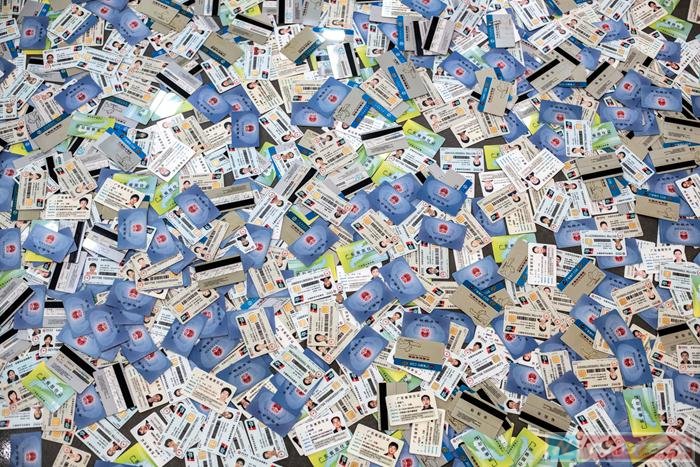
Zhan Youbing: Residence permits and social security cards left behind at a closed factory, Dongguan, China (2019)
Abu frequently complained of exhaustion. When he first arrived, he was not prepared for the hard labour, working for at least 12 hours a day, plus overtime for rush orders. During my own years on the assembly line, every day was like living in a state of constant exhaustion. Fatigue became my sole experience. We got up at 6:30 AM to reach the workshop in time for the morning meeting at 7:15 AM. These lasted 15 minutes, and usually involved being reprimanded by the duty manager. At noon we ate lunch and had a brief rest; then we resumed work by 1:30 PM. At 5:30 PM, we got off for dinner and to wash our clothes. Overtime started at 7:00 PM and lasted until 10:30 or 11 PM. Every day was a repeat of the previous day, every month was a repeat of the previous month. Assembly-line workers do one motion for just a few seconds, or even a single second, and then repeat it tens of thousands of times per day.
Abu liked to tell me about the tough crowd he ran with. He said that the foreman who’d brought them there was now rich. He drove a swanky sedan that everyone – shady or not – recognised on the roads, and they were all expected to toady to him. He threw his unfinished cigarette on the ground, his eyes gleaming with envy. Then he thought of something else: “You wouldn’t know this, but Yi girls marry young. They’re engaged to someone by the time they’re 13 or 14.” He went on: “The Yi are dumb, we’re not as clever as the Han. We’re not good at school, so we get married young and have kids. And since we’re dumb, we’re poor.”
Abu said he didn’t like Yi girls, and was going to find a Han wife. Han women had pale skin and were prettier, but they wouldn’t give him the time of day. When I asked him if he was engaged, he didn’t answer. Instead, he changed the subject to the Liangshan girls in his group. The pretty ones were often compelled to sleep with the chief. He said the chief had slept with lots of girls, including Han like me. “What do you mean by ‘the chief’?” I asked. He looked at me with disdain, bemused that I was ignorant of something that basic.
‘The chief’ was either a foreman or enforcer. “Enforcer?” Abu explained that some workers ran away when they couldn’t bear the conditions, and that the enforcer’s job was to track them down, bring them back and beat them senseless. Abu abruptly lowered his voice and said, “You wouldn’t know this, but two years ago, someone ran away twice, and the chief and his enforcers beat him to death in Chang’an. In this city, if someone kills an outsider, no one cares.”
“Are you saying if someone dies, even the police don’t take notice?” I asked.
“The chief has connections,” he said. “If he kills someone, he’s not worried. He’ll just buy his way out.”
Abu said he would like to become an enforcer within a year or two. When I asked him how one did so, he didn’t answer. Perhaps he didn’t know. What he knew was that, if he were one, he could pick any girl he liked to sleep with. Besides, their job wasn’t hard, and it didn’t involve manual labour. Abu was on to his third cigarette when I asked him about his injury. It was on the back of his left hand, a deep scar where the skin looked different. He’d been burned by a plastic injection machine in the toy factory. “That’s nothing. Some people get their fingers chopped in half.”
4.
Axiang
The first time I met Axiang, at his corrugated iron-roofed shack in Dongguan, he told me how excited he had been when Hong Kong and Macau were returned to China. This ordinary shoe factory worker, who originally came from a village in the deep interior, recounted how his bosses had paused work for these occasions. Axiang had gone to the public square to watch the festivities, and then back to the factory canteen to follow the live broadcast on TV. Several years on, he still couldn’t hide his excitement.
It was now 2002, and I was working with a fellow villager of Axiang’s at a toy factory. We stood beside each other on an assembly line producing plastic robots. I attached the left leg and she attached the right. Axiang’s factory wasn’t far from ours; many people from his village worked in the vicinity of that industrial zone.
Axiang lived on the corner of an alley in Dalang, Dongguan, in a dank, low-ceilinged, brick-built rented shack. On blustery days, the wind would howl through the gaps in the roof, and on wet days, the rain seemed to drill through and dampen everything inside. When my coworker and I went to visit him there, we found him and the others sitting on the bed playing cards bare-chested, smoking the worst cigarettes. It was early April, and already hot. The electric fan whanged about trying to keep up as the men played and shouted, sweat trickling down their dark chests. The hot air in the room grew entangled with the cheap cigarette smoke.
The 20-odd square metre shack cost 180 yuan per month. Across from the plank bed provided by the landlord, Axiang and his transient roommates had spread a thin mattress on the floor. They bought a set of metal bunk beds from a secondhand market, onto which they haphazardly tossed wooden buckets, suitcases, a big woven bag full of plastic coat hangers and crumpled clothes. Soap dishes, laundry detergent and sopping, just-washed clothes were set on the greasy windowsill. Smelly socks soaked in a cheap plastic tub.
To the left of the door was a blackened kerosene stove and a worktable – a filthy piece of plywood balanced on stacks of bricks – with a bamboo cutting board and kitchen knife, two blue plastic basins, two red colanders, a bottle of Liby dishwashing detergent, a litre of peanut oil, an open package of salt with a white plastic spoon and a few bottles of condiments like soy sauce. The nearby window’s metal frame was rusty and splattered with oil. To the right of it, a few nails had been driven into the wall, from which dangled a spatula and wok, whose blackened bottom had marred the white paint beyond recognition. In a dark, damp corner on the other side were several water bottles filled with kerosene.
We sat chatting on low, mismatched stools made of cheap pressed plastic. If a larger person had tried to sit on them, the legs would have surely snapped. Other stools in the room were made of factory plywood, with three layers of ply for the legs and two for the seat, all held together with flimsy nails from a factory nail gun. The plywood tended to split, and occasionally, with the slightest shift of position, the seat would break straight down the middle, toppling the person to the ground. The table had been welded together from bits of factory iron. It was crude but solid, with a thick slab of roughly cut wood on top. I knew Axiang had made it himself from discarded scraps.
*
Axiang had come to Dongguan in 1996, when he was 26. He was the youngest of nine siblings; their father had died when he was 17. He hadn’t found a wife and his mother was growing old, so he went to Guangdong to look for work.
In Axiang, I saw the 1970s. Or rather, I saw the remnants of the youthful ideals of that generation. They believed that the return of Hong Kong and Macau brought their country glory, and wanted to share in that elation. They still felt a fervent enthusiasm for their homeland. They wanted to discuss grand topics like the Olympics. They clung to their dreams even as they lived ramshackle lives in cramped, damp shacks.
Axiang worked in the shoe factory’s midsole workshop, pulling moulds for 12 hours a day, earning 600 yuan a month, enduring revolving day and night shifts for years. His face had an eerie pallor and his eyes were oddly hazy, like many assembly line workers. Still, he was full of fervour and liked to expound loudly on grandiose, distant matters, from the collision of planes over the South China Sea to the 1980s clashes between China and Vietnam. He almost never told stories about work, and didn’t even want to mention his coworkers or the shoes that his Taiwanese-owned factory produced. Rather, he wondered about when China would recover Taiwan.
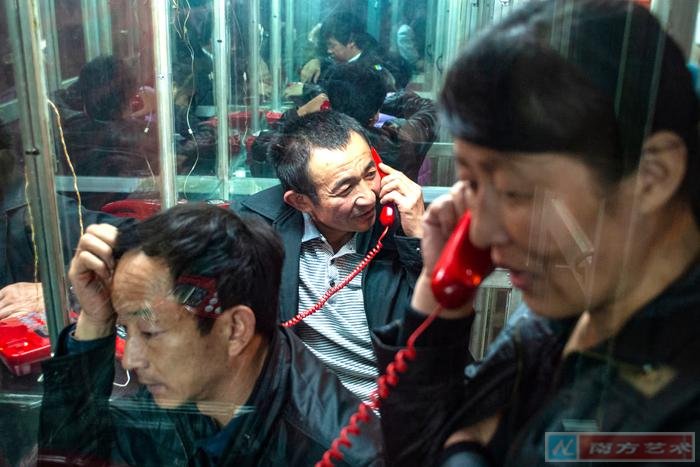
Zhan Youbing: Workers calling home, Dongguan, China (2012).
After five years at the factory, Axiang hadn’t saved any money to speak of. Still, he was loyal and generous, and as word of his factory job spread, people from his village showed up in Dongguan, and he would try to help them find a job and accommodation. Later I heard from my coworker that Axiang’s factory had folded, and its three Taiwanese owners each opened their own shoe factories. Axiang followed one of them to Shilong, where he was promoted to team leader of the sole section, in charge of some 40 workers. This allowed him to find more jobs for his fellow villagers.
He settled on a girlfriend from the same village who was 11 years younger, and they returned home to arrange the match. Following the exchange of the bridal gifts and dowry, they’d planned to get married during the New Year holiday. Instead, she took up with another man. Axiang hadn’t even gone home to try to get his money back, but his neighbours took care of it for him. Every household from their village sent someone to his former fiancée’s family home to make trouble until they negotiated. Axiang then married a woman from Chongqing, had two children, and got divorced.
*
I saw him again eight years later, in 2010. In the interval, Axiang’s factory had moved repeatedly, from Dalang to Shilong, from Shilong to Shiwan in Huizhou, from Shiwan to Baiyun in Guangzhou. I don’t know how he got my number, but he was hesitant on the phone, saying he needed my help. After I got off work, I took a bus from Tianhe to Shijiang township to see him. He was as skinny as before, and time had washed away his previous vitality. He seemed bone-tired, though he still wore a smile as he smoked. He did not talk much as we crossed the decaying industrial zone.
I was used to the atmosphere: the four- or five-storey factory buildings, the dormitories, the tightly locked iron gates and high perimeter walls with evergreens planted along them. Through a narrow window in a low building beside the gate, I saw two security guards in a room with a computer and a few monitors that showed surveillance footage from the factory’s workshops, dormitories and warehouses. We walked through to a five-storey block of rented apartments, and he told me about a fellow villager who had worked in a print shop for 11 years until he had been let go. He’d heard a rumour that the dismissed workers were entitled to compensation, but the factory refused his application. Axiang had thought of me and wondered if I had some way to help his friend.
I followed Axiang to a two-bedroom apartment on the fourth floor. It was messy, cluttered with suitcases, tables, chairs and overturned buckets. Four or five men were there playing cards, shouting out their moves. When they saw me come in with Axiang, they froze and took me in. I was an unfamiliar woman, though perhaps Axiang had told them about me. They were all very polite. A bare-chested boy of 18 or 19 stood up bashfully, entered one of the bedrooms and came back a few moments later wearing a T-shirt. He seemed embarrassed, uncertain where to look. He stood behind the other men and shyly watched them play cards.
Axiang called one of them over. Mr. Li was 47 and graying at the temples. He had come to work in Guangdong in 1995. In 16 years had been with more than a dozen factories, inching his way up from a workshop mover to an assistant manager of the gravure printing press that had dismissed him. Axiang wanted me to help Mr. Li with his workplace dispute, but instead Mr. Li dwelled on his experience at printing presses, describing the techniques used for different materials, the skills needed to manipulate ink in reverse and surface printing, and the proper way to mix and recycle new and old ink. His pride in having clawed his way up from the lowest-level labourer to a master printer was evident.
And yet this confident and experienced printer had been made redundant. He was lost and furious, and felt completely disempowered. Where Axiang’s generation had been idealistic, Mr. Li’s older cohort had lived through China’s turbulent years. They had grown up in an era of terror and chaos that had enveloped them like the air they breathed. The experience lay latent in them, unseen and unfelt, and could manifest involuntarily.
Anger and frustration had transformed those turbulent years into a mirage of equality, like a water lily burgeoning in the mind. Mr. Li now felt nostalgic for that “fervent and chaotic time”, imagining that some “saviour” would once again arise as a champion of justice. Powerless in the face of an unfair reality, the buried memory of an illusory “equality” from his youth and the common poverty of that time offered him some comfort.
His emotions welled up; I could only listen. Over the years, I’ve become accustomed to men like Mr. Li recounting their stories. After being repressed for so long in their factories, they accumulate litanies. Thousands of these men spin like gyroscopes through these places, in high-pressure print shops, amid roaring machines, with unending extra shifts, exhaustion, overwork, going on shift, getting off shift, sleeping, eating – this daily toil encompasses their entire lives. Now that he’d left the factory, he seemed to have finally managed to pour his heart out. There, in the cramped room, he made his plans to leave Shijiang.
As for Axiang, his idealism had finally been worn away, and he was now a less certain man. From 1996 to 2010, he’d put in 14 years in the shoe business, and like Mr. Li, he had become a skilled worker. But he no longer discussed grandiose, distant matters. He started talking about how his factory had moved many times, relying on Hong Kongese, Taiwanese, Japanese and American financial backing. He’d faced these different versions of the capitalist system, always on the bottom rung, experiencing starkly different management styles, and unavoidably absorbing knowledge from the outside world.
*
The last time I saw Axiang was in 2015, in Lilin, near Huizhou, where his factory had moved from Baiyun. He’d grown even more subdued. He punched his code into the door pad and we went up the stairs to his rented room on the third floor of a new six-storey building with yellow-tiled walls. There were five units on each side of a central corridor, with entrances at the front and back. He pointed to an open door, from which the sound of a television drifted, and said it was his place. A middle-aged woman, Axiang’s partner of several years, greeted me with a smile. His fellow villagers had told me that she was from Chongqing and already had a son and daughter, both of whom had dropped out of school to do manual labour there. She was two years older than Axiang and worked in the same factory. They’d never officially registered their marriage.
Over the past few years, Guangzhou’s shoe industry had undergone a rapid decline, as such labour-intensive industries relocated to the Chinese interior, south-east Asia and India. Workers had gradually retrained in other trades, and fewer villagers were seeking Axiang out for a job. His own factory had tried to hold on. He’d been in the business for 20 years, and all he could say was: “There are fewer factories here, fewer people.” He recounted how his friends had moved on to the Yangtze River Delta, Beijing, Changsha, Wuhan, Xinjiang or the north-east. Some had put down roots in the city, and only he was continuing to stick with the factory, drifting between cities in the Pearl River Delta. He had no idea where its next relocation would be. He seemed bemused and distressed. As he started to recall the old days, I sat in his small, rented room of 20 square meters – with its little balcony, kitchenette, cold-water shower and toilet, and even a television, computer and internet – and remembered our earlier meeting 13 years ago, in that dank, low-ceilinged shack with a roof of corrugated iron at the end of the alley and the blackened kerosene stove…
Axiang no longer spoke about grandiose, distant things. Now he asked me questions about pension insurance. He’d got used to urban life. Even if he couldn’t live in factory housing, he would stay in the city rather than return to his village.
A decade earlier, Axiang and I had both been torn between two internal forces: the distant, quiet, impoverished, traditional villages that remained our ancestral homes, and the reinforced-concrete city, inaccessible and bristling with hostility, where we intended to put down roots. At the mercy of economic fluctuations, we travelled between the city and the village as though pushed by invisible tides that washed over city and village alike. Amid this relentless back and forth, villages had begun to imitate the city. In Axiang’s village, most people had moved out of the mountain passes and built houses along the main road or on the outskirts of nearby towns. Fewer and fewer people remained in the mountains.
When I first met him, Axiang had wanted to make some money and return home, but that idea had been scrubbed out of his head. Among his generation, more than half of those who came to the city were eventually compelled to return to their villages.
Although we live in the silence and deprivation of the lowest rungs of society, where hard labour and poverty constitute the flow of life, we still believe that the world will improve with our efforts. We haul our heavy luggage, finding a way out of poverty-stricken villages, along roads that are rough and mired in mud. But we still believe that we shouldn’t compromise or accept a mediocre life; we must preserve our inner ferocity, and maintain a dream’s distance from the world – a distance that gives us the motivation to pursue our ambitions. I’ve faced the implacable reality many times, and tried to tell myself: don’t waver, don’t be weak. Otherwise, this era will engulf you.
→Zheng Xiaoqiong is a Chinese poet from Nanchong, Sichuan. She worked in a local hospital before relocating to the industrial city of Dongguan, where she worked on factory assembly lines and wrote poems centred on industrial labour and the experiences of migrant workers.
→Eleanor Goodman is a writer and translator. She is an affiliate of the Harvard University Fairbank Center as a Nonresident Associate in Research.
郑小琼附言:《equator》刊发散文《赵芳》《阿红》《凉山工人》《阿翔》,感谢顾爱玲的翻译和唐朝乐队吉他手郭怡广的推荐,也感谢占有兵的照片。




 川公网安备 51041102000034号